There is no real-time monitoring of our airspace
Drones, aircraft, and unknown objects cross sensitive airspace every day. Existing systems may flag a contact — but without real-time 3D position and kinematics, they can't characterize it, identify it, or assess the threat.
The skies aren't secure
Drones cross sensitive airspace daily — the FAA logs 100+ sightings a month near US airports, and the operators are almost never identified.
A detection isn't an identification
Radar and RF tools return a blip, not an answer. Without real-time 3D position, altitude, speed and heading — and a look at the object itself — you can't tell a survey drone from a hostile one, or judge whether it's a threat at all.
They don't fit most sites
Conventional radar and RF systems are active (they emit), need spectrum permits and grid power, run $0.5–2M+, and take months to install — so airports, prisons, stadiums and borders are left with no coverage at all.
Intelligent multimodal
sensor nodes
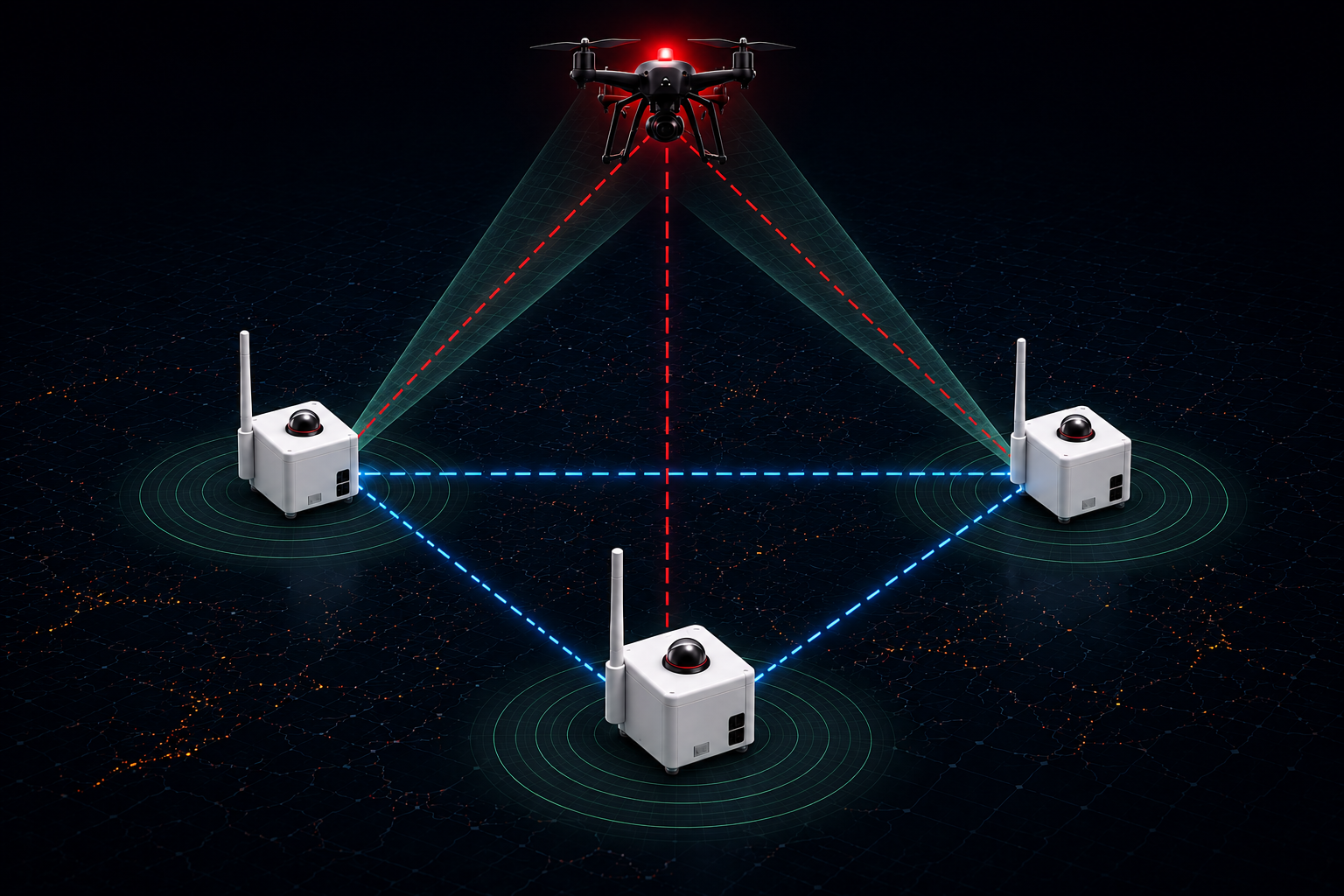
Most sensors are dumb pipes. Ours understand what they see, hear and sense — camera, RF / ADS-B, acoustic and IR fused on-device — and report only intelligence, not raw data.
Threat, demand, and regulation are converging now
Three forces make this buildable. A fourth means the budget is already moving.
The threat went transnational
A multi-day drone wave hit 10+ NATO countries and 15+ airports in 2025 — and the operators went unapprehended.
Detection is the legal play
Non-federal sites can't legally jam or intercept, so they must detect. Demand is urgent and detection-first.
Regulation forces adoption
FAA Remote ID enforcement drove a 35% jump in detection deployments. TSA counter-drone test beds are live.
The category is funding up
Counter-UAS is $6.6B today, $20.3B by 2030 (25% CAGR). Dedrone's acquisition by Axon proved the exit.
Competitive Advantage
We're not just building sensors. We're building the only passive, calibrated, multi-sensor record of what's actually in the sky — and it compounds with every node.
Network effects
Every node added makes the whole network more valuable. Shared intelligence compounds into a perception layer no single deployment can match.
Proprietary data asset
Our nodes build a unique, real-time record of what's actually in the sky — a calibrated dataset no one else holds, and it grows more valuable every second.
Edge-first architecture
Detection happens on-device; only intelligence — not raw data — leaves the node. Privacy by design, and millisecond latency.
Hardware opens the door. Software and data create recurring, high-margin value at scale.
Be first on the network
Nodes aren't open to the public just yet. Tell us about you and we'll reach out the moment they're ready — with priority access for pilot partners.